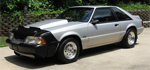
351 Screamer: Lidio Iacobelli is ready to make headlines again
Ok, admit it. At one time or another you've sat around dreaming about
the ultimate Mustang you'd like to build. Heads, cam, blower, and nitrous
included, of course. What seperates Mustang owners; however, is that some
make their dream
come true. Some owners have connections, some get sponsers, and most just spend
lots of money to make it happen. Then once in a while, someone comes along
that not only makes their dream happen, but helps to make ours happen as
well. Lidio Iacobelli...
[Read More]
[01/16/2026] 2026 Ford Mustang Dark Horse SC Unveiled
By: Dan McClain - MW Staff
Ford Racing Redefines the Track-Focused Street Mustang
On Thursday evening, January 15, Ford Racing officially unveiled the 2026 Mustang Dark Horse SC at its 2026 Season Launch event, and the message was unmistakable. This is not a styling exercise, a nostalgia play, or a half-step special edition. The Dark Horse SC is Ford Racing’s most serious attempt yet at delivering a race-developed Mustang for the street, and it effectively assumes the role once occupied by the Shelby GT500.
With Ford no longer holding rights to use the Shelby name, the responsibility of carrying the Mustang’s flagship performance identity now sits squarely with Ford Racing and Ford Performance. The Dark Horse SC is the result. Positioned above the standard Dark Horse and below the extreme Mustang GTD, it establishes a new internal hierarchy defined less by branding and more by engineering intent.
The Dark Horse SC program was led by Arie Groeneveld, a 30-year Ford veteran whose career spans powertrains and plant leadership, but who had never previously had the privilege of working on a Mustang. When asked to serve as chief program engineer for a new high-performance Mustang from Ford Racing, he framed the assignment as a rare honor, pointing to the Mustang’s unique emotional gravity and Ford Racing’s track-first culture.
From the outset, this car was not developed in a vacuum. The Dark Horse SC was engineered by teams who live their lives at racing circuits, and that mentality is baked into every bolt and calibration. Ford took the SC to Sebring and Virginia International Raceway and tested it alongside the Mustang GTD supercar and the Mustang GT3 race car. That decision shaped the car in a way that typical “track-tested” claims often do not. It created a development environment where data, hardware, and lessons could move across programs in real time.
That collaboration produced immediate outcomes. The Dark Horse SC Track Pack adopts Brembo carbon-ceramic brakes and Michelin Pilot Sport Cup 2 R tires, both rooted in GTD-level performance targets. The SC’s aerodynamic changes, including a new hood with carbon-fiber venting, revised fascia, and underbody venting, were informed by the same kind of track data-sharing that usually stays inside racing programs.
Just as importantly, the relationship was not one-directional. During SC development, the team engineered a ducktail-shaped decklid for Track Pack models that improved the rear wing’s efficiency by 10 percent without requiring a larger wing or a higher angle of attack, both of which could compromise rear visibility. The improvement was meaningful enough that the GTD team adopted a similar approach for the supercar.
Powertrain: Familiar Hardware, Sharpened Focus
At the core of the Dark Horse SC is a supercharged 5.2-liter V8 paired to a seven-speed dual-clutch transmission. The story here is not merely “more power.” It is that Ford chose the hardware best suited to repeatable track performance. The DCT is the only transmission offered, a decision that will frustrate some purists but aligns with the SC’s mission: deliver fast, consistent shifts and keep the drivetrain stable under sustained heat and load.
Ford has not released official horsepower and torque figures yet. What has been communicated is that the SC is designed to sit in the top tier of the Mustang stable, between the Dark Horse Performance Package and the Mustang GTD. That positioning matters, because it implies an output level and performance envelope that will compete at the very sharp end of modern street Mustangs, while remaining distinctly separate from the GTD’s halo status.
The Real Story: Vehicle Dynamics and the “Relentless Pursuit of Physics”
While the supercharged 5.2-liter soundtrack will get the headlines, Ford Racing’s most compelling case for the Dark Horse SC is vehicle dynamics. The SC is presented as a total integration of hardware and software, designed to make the platform faster, more stable, and more controllable under the kinds of loads that expose weaknesses quickly.
Next-generation MagneRide dampers anchor the suspension, paired with revised spring rates and updated knuckles, plus forged links replacing standard steel components to reduce mass and increase precision. A lightweight magnesium strut tower brace further tightens the front structure to sharpen steering response and feedback.
Ford’s message is clear: power is easy. Control is hard. The SC’s development choices reflect that reality.
Track Pack: Where the SC Becomes a Different Animal
The optional Track Pack is where the Dark Horse SC’s engineering philosophy becomes impossible to ignore. By utilizing carbon-fiber wheels and Brembo carbon-ceramic brakes, Ford says it stripped roughly 150 pounds of weight from the Track Package configuration. The value is not just static weight reduction. Much of that mass is unsprung and rotational, which means the improvements show up immediately in braking consistency, steering response, transient behavior, and the car’s willingness to change direction under load.
Track Pack tire fitment is equally aggressive: a 20x11.5 square setup wrapped in Michelin Pilot Sport Cup 2 R tires. That combination is a direct declaration of intent. A square setup with that width is about maximizing contact patch, enabling rotation without relying on stagger as a crutch, and allowing the chassis to work in a more neutral, predictable window at the limit.
Aero and Cooling: Functional, Track-Proven, and Measurable
The aerodynamic profile of the Dark Horse SC was another area where the team refused to compromise. The new aluminum hood features a massive vent designed to improve powertrain cooling and manage front-end dynamics. Ford states that when the hood vent tray is removed, it creates 2.5 times the downforce of the standard Mustang Dark Horse hood vent.
Out back, Track Pack models add a carbon-fiber wing designed to generate serious stability at speed. Ford claims the Dark Horse SC with Track Pack produces 620 pounds of rear downforce at 180 mph. That is not a cosmetic number. That is the kind of load that changes tire behavior, braking zones, and the driver’s ability to commit to high-speed corners.
And then there is that ducktail-shaped decklid. Improving wing efficiency by 10 percent without increasing wing size or angle is a pure engineering win, and it is rare to see a street Mustang program explicitly prioritize downforce efficiency and visibility tradeoffs the way race teams do.
Driver-Facing Tech: Variable Traction Control That Actually Matters
One of the SC’s most important pieces of technology is the Variable Traction Control system, delivered with five distinct levels of adjustment plus the ability to fully deactivate ESC. This is a meaningful departure from the typical “one size fits all” traction strategy found on many performance cars.
For track-focused drivers, granular traction control is not a gimmick. It is a tuning tool. It allows the driver to manage slip angle, tire temperature, and throttle application based on surface conditions and personal style. That is especially relevant for a car designed to run Cup 2 R tires and carry significant aero load at speed.
Interior: GTD Influence, Purposeful Materials, and Track-First Options
Inside, the Dark Horse SC brings GTD cues into a more accessible package. The car adopts the GTD’s leather-wrapped flat-bottom steering wheel with a 12 o’clock stripe and integrated performance controls. Alcantara and carbon-fiber accents reinforce the car’s motorsport tone without leaning on cheap theatrics.
Track Pack cars add optional Recaro leather and Dinamica sport seats and replace the rear seats with a storage shelf. Accent choices include Space Gray or Teal, with the Teal Accent Package positioned as a heritage nod to Grabber Green-era Boss Mustangs. Whether that color is your taste or not, the important point is that Ford is offering enthusiasts real configuration choices rather than forcing a single “special edition” template.
For those who want the most exotic details, the Dark Horse SC Special Edition brings 3D-printed titanium accents into the cabin, a trickle-down from the GTD program that speaks to Ford’s “every gram matters” mindset at this level.
Where It Sits, and Why That Matters
The Dark Horse SC is positioned in the top tier of the Mustang lineup, between the Mustang Dark Horse Performance Package and the Mustang GTD. That placement is strategic and necessary. The standard Dark Horse is already a capable foundation, especially on the S650 chassis, but the SC is Ford Racing pushing the platform into true track weapon territory with a cohesive package: supercharged power, DCT consistency, serious brakes and tires, meaningful aero, and driver-adjustable controls.
At the same time, Ford is leaving the GTD as the halo. The SC is not trying to be a limited-production supercar. It is aiming to be the most advanced, most track-capable Dark Horse yet, and to deliver that capability in a package that owners can drive, learn, and exploit.
Timeline and What Comes Next
Pricing has not been announced. Ordering is expected to open in Spring 2026, with deliveries slated for Summer 2026. What is already clear is that Ford Racing is building the Dark Horse SC around repeatable performance, not one-hit hero metrics.
The Dark Horse SC is a high-powered Mustang that many did not see coming, but it is exactly what happens when you let racing engineers design a road car. If Ford delivers on the calibration polish and production consistency implied by its development story, this will be the Mustang that redefines what “factory track-capable” actually means in the modern era.
By MustangWorks.com Coverage from the Ford Racing 2026 Season Launch event, January 15